First Generation
Production 1929 - 1936
Bore 3.3125 in (84.1 mm)
Stroke 3.75 in (95.3 mm)
Displacement 194 cu in (3.2 L)
Power output 50 hp (37 kW)
The first mass-produced GM inline-6 was introduced in 1929 on Chevrolet cars and trucks, this engine replaced the inline-4. The straight six stovebolt engine was produced from 1929 to 1936.
A balanced crankshaft was introduced for 1932, while a higher (5.2:1) compression ratio upped output to 60 hp (45 kW). A new cylinder head two years later pushed output to 80 hp (60 kW).
From 1954 to 1963, the high-pressure 235-cubic-inch engine with mechanical valve lifters was used in trucks. From 1956-1962, all 235-cubic-inch engines used in cars had hydraulic lifters.
The 1953 Corvette engine had the high-pressure 235-cubic-inch engine equipped with mechanical lifters. A 150 hp 235 engine was used in the 1954 Corvette and into 1955. The 235 ci Corvette used the same highlift camshaft as used in the 261 truck engine and triple side draft Carter carbs & a Powerglide transmission & a dual outlet exhaust manifold. The 235 and 261 truck engines were also used by GMC for truck in Canada.

Third member of the Chevrolet inline 6 family was introduced in 1962 to 1988.The new engine was lighter and had a different bell housing bolt pattern. Both auto & manual bell housings & starter motors became interchangeable with Chevy small block and big block V8s.
Other changes on the 3rd generation engine was the crankshafts now had 7 main bearings not 4 like the earlier straight six, Chevrolet decreased the stroke from 3.9375" to 3.25 to produce a 230 ci engine. A new wedge type combustion chamber like the V8 was also used. The valve train was changed from a shaft type & an increase from 1.5 to 1 ratio was increased to 1.75 to 1 like the big block chevys used, Chevrolet passenger cars used the new style engine until 1977, In the Camaro,Chevy Nova & full size trucks it was used until 1979. These vehicals previously used the Stovebolt sixes. In the mid-1970s, the V6 engine like the Buick V6 231& later the 200 ci & in the 1980 the 229 3.8 V6 Chevy to over from the inline six in passenger car. GM continued to use the inline 6 in trucks and vans until 1988. Brazil used the straight six in the Chevrolet Opala from 1969 to 1992 . The inline Chevy six were converted for marine use by Volvo Penta & mercrusier & were also used to run power generation & used in forklifts.
1962-1969 Chevy II
1967-1971 Postal Jeep
1968-1992 Chevrolet Opala (Brazil)
1962-1967 Chevy II
1964-1967 Chevrolet Chevelle
1965-1966 Studebaker Commander, Daytona 1966 only, Cruiser and Wagonaire
The 230 Replaced 235 cubic inches (3.9 L). It was also used by Chevrolet and GMC trucks, primarily the half-tons. It produced 140 hp (100 kW). The 230 had a firing order of 1-5-3-6-2-4 rotating clockwise. This engine was used on the following vehicles:
1964 Chevrolet Chevelle
1965-1968 Checker Marathon
1965 Chevrolet El Camino
1966-1970 Chevrolet Nova
1966 Studebaker Commander, Wagonaire, Daytona and Cruiser
1967 Chevrolet Chevelle
1967 Chevrolet Camaro
1968 Chevrolet Chevelle Malibu
1969 Chevrolet Camaro
1969 Chevrolet Chevelle
The Pontiac 3.8 was a special SOHC version of the standard 230-cubic-inch (3.8 L) I6. An optional W53 version on the Firebird produced 215 hp (160 kW).
This engine was used on the following vehicles:
1967 Pontiac Firebird
1967 Pontiac Tempest Sprint coupe
The stroked 250 version produced 155 hp (116 kW) for Chevrolet and GMC. Between 1975 - 1984, an integrated cylinder head was produced, with one-barrel intakes for passenger cars, and two-barrel intakes for trucks after 1978.
Passenger car use of the 250-cubic-inch (4.1 L) engine was discontinued after the 1979
1966-1984 Chevrolet (passenger cars to 1979, trucks/vans to 1984)
1968-1976 Pontiac Firebird
1968-1970 Pontiac Tempest
1968-1976 Pontiac LeMans
1968-1969 Buick Special
1968-1972 Oldsmobile F-85
1975-1976 Oldsmobile Cutlass
1971-1975 Pontiac Ventura
1968-1971 Buick Skylark
1968-1979 Chevrolet Camaro
1969-1979 Checker Marathon
1968-1992 Chevrolet Opala (Brazil)
The L22 was a 250-cubic-inch (4.1 L) I6 engine produced from 1967 to 1979. The '78 Camaro had 105 horsepower (78 kW) and 190 ft·lbf (260 N·m) of torque with the 250.
The LD4 was a 250-cubic-inch (4.1 L) I6 engine produced strictly in 1978.
The LE3 was a 250-cubic-inch (4.1 L) I6 engine produced from 1979 to 1984.
The 292 was only used in Chevrolet and GMC trucks; the block deck is taller, along with a relocated passenger-side engine mount. These were produced between 1963 to 1990; production of the engine shifted to Mexico after 1984.
The L25 was GM's "last" pushrod straight-6 engine, produced from 1977 to 1988. It was used in Chevrolet trucks, displaced 292 cubic inches (4.8 L) and produced 115 hp (86 kW) and 215 ft·lbf (292 N·m).


Chevy Straight six engine specs bore and stroke sizes
194: 3.563x3.25
215: 3.750x3.25
230: 3.875x3.25
250: 3.875x3.53
292: 3.875x4.125
firing order
1-5-3-6-2-4
Chevrolet straight six engine were available in many body styles.
Chevy Nova
Chevrolet Camaro
Buick Apollo
Buick skylark
Pontiac Firebird
Tempest, LeMans
Chevelle/Malibu
Buick Special/Grand Sport
Biscayne/Bel Air/Impala/Caprice
Chevy Blazer
Chevy pickup trucks
GMC trucks
Chevy straight six crankshaft strokes.
Straight six Chevrolet crankshafts from these engines will interchange. There are 3 basic crank types.
194/230 (3.25" stroke)
250 (3.53" stroke)
292 (4.125" stroke)
The 292 cubic inch straight six engine has a different conrod journal diameter. When swapping cranks it is recommended both crank & rods be swapped as an assembly.
Some parts that will & wont interchange between Chevy engines
starter motors,
Most chevy sixes run a through bell housing starter motor
harmonic balancers,
Do not interchange with small block or v6 chevys as the pulley on the balancer is integrated with the balancer, bolt on pulleys are used to run air con,power steering & air pumps.
Push rods,
The pushrod length on the chevy six is a length of its own & will not interchange with small or big block Chevrolets
Conrods & rod bearings,
Due to rod length & big end sizes they do not interchange with v8 engines.
rocker arms & roller rockers,
Despite having a ratio very similar the rocker length is not the same
camshafts and timing gear sets,
The 292 chevy six does not interchange with the smaller cube engines.
Fuel pumps,
292 Chevrolet straight six engines had the fuel pump switched to the other side of the engine block, The lobe on the camshaft that operates the fuel pump lever is not in the same location as the smaller cubic inch engines.
crankshaft tunnel alignment is very important when changing rotating assemblies .
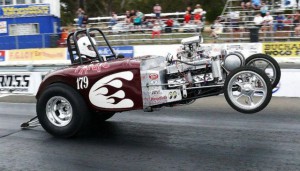
This mad straight blown six cylinder powered flamed altered leaving the line...in a case like this "6 in a row is the only way to go"
Cylinder head torque settings on chevy inline 6 cylinder engines should be pulled down in 3 stages.
first stage 40 foot pounds
second stage 60 foot pounds
final stage 85 foot pounds on the 2 front cylinder head bolts & 95 foot pounds on all other head bolts except the front 2.it is recommended to install the water pump before doing up the head bolts
allways start in the center & go from left to right & work out towards the ends.